
Calgary Hard Water: Why Scale Builds Up and How to Clean It Safely
Learn why Calgary hard water causes limescale and how to clean mineral buildup safely. Discover simple tips for a cleaner home today.
September 16, 2026
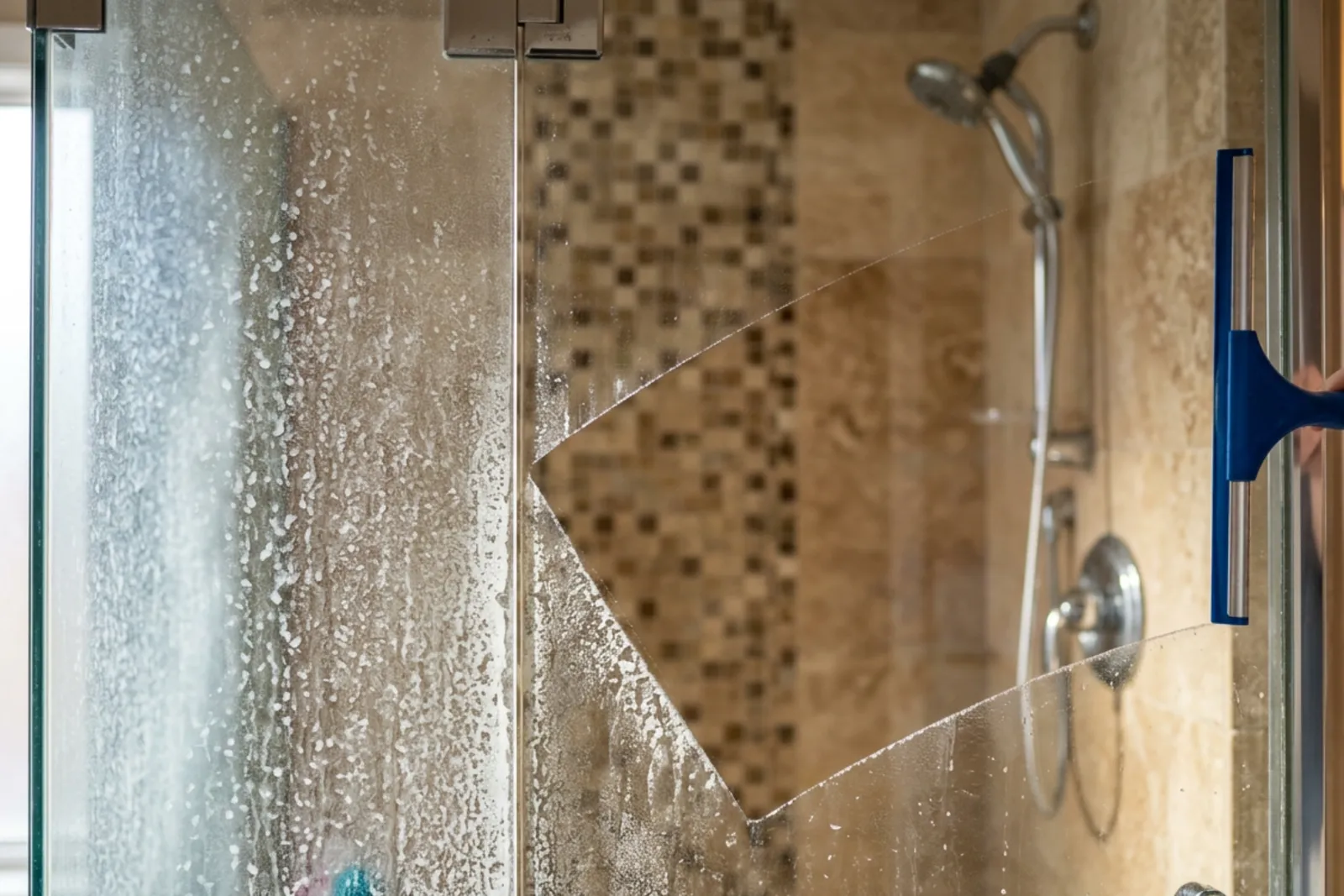
If you live in Calgary, you have probably seen it: cloudy shower glass, a chalky ring around a faucet, white spots on a dark kitchen sink, or a kettle that slowly develops a crust inside. It can feel like the bathroom looks dirty again almost immediately after cleaning.
Usually, the problem is not dirt. It is hard-water scale.
Calgary’s drinking water is considered safe and high quality, but it contains naturally occurring calcium and magnesium. Those minerals are harmless at the levels found in municipal water, yet they leave behind visible deposits when water dries on a surface. For homeowners, renters, and anyone responsible for a workplace, understanding that distinction makes cleaning a lot less frustrating.
Hard water does not mean unsafe water. It means you may need a slightly different cleaning routine.
What makes Calgary water hard?
Water becomes hard when it contains dissolved minerals, mainly calcium and magnesium. Calgary’s source water comes from the Bow and Elbow river systems, where natural erosion and the dissolution of rock, including limestone, add these minerals to the water.
The City of Calgary monitors water quality closely through accredited laboratories that operate under ISO/IEC 17025:2017 requirements. Testing has increased substantially in recent years, with more than 208,000 drinking-water tests completed in 2025. The city reports that Calgary’s drinking water is safe and meets its quality requirements.
Still, water can be safe to drink and annoying to clean with. Those are two separate things.
When hard water splashes onto a surface and evaporates, the water disappears but the minerals stay behind. Over time, the leftover calcium and magnesium form a pale, crusty deposit commonly called limescale, mineral scale, or hard-water buildup.
The effect is especially obvious in places where water lands repeatedly:
Shower doors, glass panels, tile, and tub surrounds
Faucets, sink basins, drains, and chrome fixtures
Kitchen taps and counters near the sink
Kettles, coffee makers, humidifiers, and other small appliances
Toilet bowls, especially around the waterline
Dark stone, glass, and polished metal, where white spots show quickly
A spotless fixture can look dull after one or two showers if water droplets are left to dry. That is the frustrating part. Scale is persistent, but it is also predictable.
Water hardness is not the same everywhere in Calgary
Calgary does not receive identical water across the entire city. The north and south are mainly supplied by different treatment plants and river sources.
Northern Calgary generally receives water from the Bow River through the Bearspaw Water Treatment Plant. Southern Calgary primarily receives water from the Elbow River through the Glenmore Water Treatment Plant. The two watersheds have different mineral profiles, so hardness levels vary.
In the city’s 2025 reporting, the overall hardness range was 141 to 274 milligrams per litre as calcium carbonate, written as mg/L CaCO3. In everyday terms, that is firmly in hard-water territory.
Bearspaw-treated water ranged approximately from 141 to 200 mg/L CaCO3 across the year. Glenmore-treated water ranged from about 181 to 274 mg/L CaCO3. The Glenmore supply was generally harder during 2025.
That difference can be noticeable. A household in the south may find that shower glass, faucets, and kettle interiors collect scale more quickly than a household using primarily Bearspaw-supplied water. Plumbing zones can be complicated, though, and a home near a boundary or served through interconnected infrastructure may not fit a simple north-versus-south rule.
Season matters too. Hardness is usually lowest during spring snowmelt, when river flows increase and mineral concentrations are diluted. It tends to be highest between December and February. If the glass in your shower seems especially difficult to keep clear in winter, you may not be imagining it.
Why hard water changes the way cleaning products work
Hard water affects soap and detergent performance because calcium and magnesium react with certain cleaning ingredients. Traditional soap may form a film rather than rinsing away cleanly, and it can take more product to create lather.
That does not mean every cleaner fails in hard water. Many modern detergents are formulated with ingredients that bind to minerals and keep them suspended in water. But the difference is real, especially with bar soap, some body washes, hand soap, and products that are not designed to rinse easily.
In the bathroom, soap residue and mineral scale often combine. This creates a stubborn dull film that is harder to remove than either problem on its own. On shower doors, for example, a cloudy appearance may be a mix of dried minerals, body oils, soap residue, and cleaning-product buildup.
The same thing happens around kitchen sinks. A faucet may have white mineral spots on the outside, while the aerator inside slowly clogs with scale. One is cosmetic. The other can reduce or distort water flow.
This is why wiping a faucet with an all-purpose cleaner may make it look better briefly without actually removing the hard-water deposit. The cleaner may lift grime, but mineral scale generally needs an acid-based descaler or a product specifically made for calcium buildup.
Recognizing scale before it becomes a bigger cleaning job
Fresh hard-water spots are usually easy to remove. Old scale is another story.
At first, deposits often look like tiny white dots or a hazy film. Left alone, they can become rough, chalky, or crusted. On chrome fixtures, buildup may collect around the base of the tap and where the spout joins the body. In toilets, minerals can form a pale ring that turns yellow, orange, or brown when iron or other residues become involved.
Shower glass is where people often run into trouble. The surface may feel smooth but look cloudy, or it may feel slightly rough when you run a fingertip over it. Once mineral deposits have remained for months, they can bond tightly to the glass. Aggressive scrubbing may scratch the surface without restoring its clarity.
There is a practical lesson here: frequent light maintenance beats heroic cleaning sessions.
A dry microfiber cloth after a shower is boring advice, I know. It also works. Removing water before it evaporates prevents most mineral spotting. A squeegee takes less than a minute and can make a big difference on glass enclosures.
A safe approach to removing hard-water scale
The right cleaning method depends on what the surface is made of. Acidic products dissolve mineral deposits well, but that strength can damage sensitive materials. Natural stone, some painted finishes, unsealed grout, certain metals, and specialty coatings need more care.
Before using any descaler, check the manufacturer’s care instructions for the fixture or surface. Test a small, hidden area first. This matters most in high-end homes with honed stone, custom millwork, decorative metalwork, or specialty tile. A cleaner that works perfectly on ceramic tile can permanently etch marble.
For most standard glass, ceramic, porcelain, and chrome surfaces, this process is a sensible starting point:
Remove loose dirt and soap residue first with a mild cleaner and a soft cloth. Scale-removing products work better when they are not fighting grease and grime at the same time.
Apply a suitable descaling product. A commercial cleaner labelled for limescale is often the most reliable choice. A diluted vinegar solution can help on compatible surfaces, but it should never be treated as universally safe.
Let the product sit briefly, following the label directions. Do not let it dry on the surface.
Wipe gently with a non-scratch sponge, soft brush, or microfiber cloth. Avoid steel wool, harsh scouring powders, and abrasive pads, especially on glass, chrome, acrylic, and polished finishes.
Rinse thoroughly and dry the area completely. Drying is part of the job, not an optional final touch.
For shower heads and faucet aerators, a removable component can often be soaked in a suitable descaling solution, then rinsed and reinstalled. If a fixture is older, corroded, or difficult to remove, forcing it can cause more damage than the scale itself. In that case, clean what you can safely reach or ask a plumber for help.
Where vinegar is useful, and where it can cause damage
Vinegar gets recommended constantly because it is inexpensive and acidic enough to dissolve light mineral buildup. For certain jobs, it is useful. It can work on shower glass, ceramic tile, porcelain, and removable faucet aerators, assuming the manufacturer allows it.
But vinegar is not a universal natural cleaner. It can etch calcium-based stone such as marble, travertine, limestone, and terrazzo. It may dull some finishes, damage unsealed grout, and affect certain rubber seals or specialty coatings when used repeatedly.
That is worth saying plainly because “natural” does not automatically mean gentle.
If you have natural stone counters, stone tile, or a stone shower surround, use a pH-neutral cleaner intended for that material. If mineral spotting persists, ask the stone fabricator, installer, or manufacturer for approved descaling guidance. The wrong shortcut can leave permanent dull spots that look worse than the original scale.
The same caution applies to decorative brass, black fixtures, and matte finishes. These surfaces are popular, but many are less forgiving than traditional chrome. Avoid abrasive tools and strong acids unless the fixture maker specifically approves them.
Preventing scale with a realistic cleaning routine
You cannot remove calcium and magnesium from your tap water through better housekeeping. What you can do is stop minerals from drying onto surfaces in the first place.
A few small habits are more effective than waiting until scale becomes visible. Squeegee shower glass after use, dry faucets and sink edges with a microfiber cloth, and avoid leaving wet cloths or bottles sitting on stone counters. In kitchens, wipe around the base of the faucet and behind the handles where water tends to collect unnoticed.
For a regularly used bathroom, a quick weekly cleaning prevents most buildup. A more thorough descaling session every few weeks may be needed in homes with hard water, frequent showers, or glass enclosures. Commercial cleaning spaces, offices with staff kitchens, and rental properties may need more frequent attention because many people use the same fixtures.
Appliances deserve attention too. Kettles and coffee machines often provide the clearest evidence of hard water because the water is repeatedly heated and evaporated. Follow the appliance manufacturer’s descaling schedule. This protects performance and can extend the appliance’s life.
Should Calgary households use a water softener?
Water softeners reduce hardness by removing calcium and magnesium, usually through an ion-exchange process. Conventional systems commonly use sodium to replace hardness minerals. They can reduce scale, improve soap lather, and help some appliances operate with less buildup.
That said, a softener is a household decision, not a universal requirement.
The City of Calgary reports no known health effects from the calcium and magnesium in its drinking water. These minerals are not a contamination issue. They are simply part of the water’s chemistry.
People following sodium-reduced diets should be cautious about conventional salt-based softeners, since treated water can contain more sodium. Anyone considering a system should research its operation, maintenance needs, wastewater discharge, cost, and suitability for their household. Some people soften water for bathing and laundry while keeping a separate unsoftened drinking-water line. Others decide that regular descaling is simpler and less expensive.
There are also salt-free devices marketed as water conditioners. These may change how minerals behave, but they do not remove hardness in the same way as an ion-exchange softener. Claims vary widely, so read independent information and product documentation carefully.
Hard water is manageable, even when it is annoying
Calgary’s hard water comes from natural minerals in the Bow and Elbow river systems. The minerals are safe, but they leave a visible reminder whenever water evaporates on glass, fixtures, appliances, and counters.
The most useful response is not harsher scrubbing. It is a better routine: clean scale with products suited to the material, rinse well, dry surfaces after use, and deal with fresh spots before they harden into crusty deposits.
If your shower door seems to cloud up too quickly, blame the chemistry before blaming your cleaning skills. In Calgary, a little extra mineral management is simply part of keeping a home clean.