
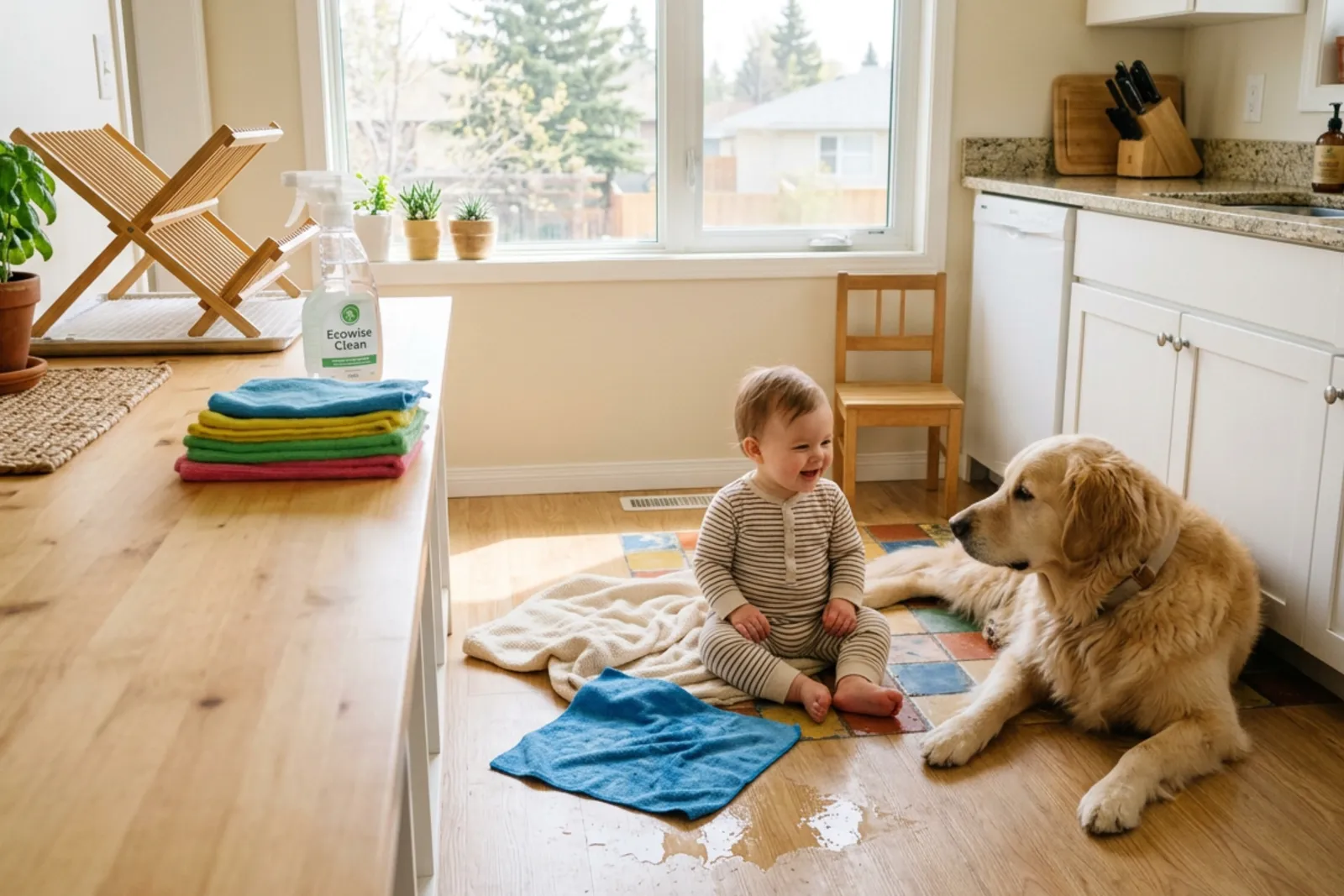
Low-Tox Cleaning for Calgary Homes: A Practical Guide for Families and Pets
Learn low-tox cleaning tips for Calgary homes, including safer choices for kids, pets, allergies, and hard-water messes. Read the guide.
September 15, 2026
A clean home should feel comfortable, not like a cloud of perfume or a chemistry experiment. For Calgary households with babies, pets, allergies, asthma, or fragrance sensitivities, low-tox cleaning can reduce unnecessary exposure to irritating ingredients while still handling everyday messes, hard-water scale, and seasonal grime.
The goal is not to sanitize every surface all day long. That is exhausting, expensive, and usually unnecessary. It is to use the right product for the job, clean thoroughly, and reserve disinfectants for moments when they actually matter.
Calgary adds a few local wrinkles: mineral-heavy water, very dry winter air, road salt, and sudden temperature changes that can leave moisture on windows. A thoughtful low-tox routine can deal with all of them.
What “Eco-Friendly” and “Non-Toxic” Actually Mean
Terms such as “natural,” “eco-friendly,” “green,” “plant-based,” and “non-toxic” sound reassuring. The trouble is that they are not tightly defined or consistently enforced claims on cleaning products in Canada.
A bottle can have green leaves on the label and still contain synthetic fragrance, preservatives, or surfactants that irritate skin and airways. Plant-based ingredients are not automatically harmless, either. Poison ivy is natural. So are many essential oils that can be unsafe around cats.
Instead of trusting front-label language alone, turn the bottle around. Look for a complete ingredient list and credible third-party certifications.
Some useful certifications include:
ECOLOGO, which evaluates products for reduced environmental and human-health impacts.
Green Seal, which sets standards for lower toxicity and ingredient transparency.
EcoCert, which assesses natural-origin and biodegradable formulation standards.
Leaping Bunny, which verifies that a product and its supply chain do not involve animal testing.
EWG Verified, which indicates that a product avoids ingredients on the Environmental Working Group’s concern list.
No certification removes the need to read directions, dilute concentrates properly, or keep products away from children. Still, certification is more meaningful than vague packaging claims.
One word deserves particular caution: “fragrance” or “parfum.” It can refer to a mixture of many undisclosed chemicals. A scented product may smell like lavender, citrus, or fresh linen without containing much of the plant named on the label. Fragrance has no cleaning function. It exists to leave a scent behind, which is exactly why fragrance-free cleaning makes sense for many homes.
Why Fragrance-Free Cleaning Matters for Babies and Pets
Adults tend to experience a clean home at countertop height. Babies and pets experience it much closer to the floor.
A crawling baby touches flooring repeatedly, then puts their hands in their mouth. Dogs and cats walk through recently cleaned areas, then groom their paws. Any cleaner that leaves a residue deserves more thought when the household includes these small, close-to-the-ground family members.
Calgary’s dry climate makes this more relevant. Winter humidity indoors can fall below 20 percent, especially in heated homes. As liquid residue dries, tiny particles can become part of household dust. Dry dusting often sends those particles back into the air. Heavy fragrances can linger there too.
For people prone to asthma, migraines, allergies, or chemical sensitivities, scented cleaning products can be a real nuisance. The reaction may be coughing, a headache, watery eyes, or that vague throat irritation that disappears when the scented plug-in is removed. It is easy to dismiss these symptoms, but there is little upside to adding fragrance chemicals to the air in the first place.
Fragrance-free does not mean a home has to smell unpleasant. A genuinely clean room often has almost no smell. That is a better standard than “mountain breeze.”
Ingredients Worth Avoiding When Practical
There is no single perfect product for every mess, but some ingredients deserve extra care or are easy to avoid in routine home cleaning.
Ammonia
Ammonia appears in some glass and multipurpose cleaners. Its fumes can irritate the eyes and respiratory system, particularly in small bathrooms or poorly ventilated rooms. It also creates toxic chloramine gas when mixed with chlorine bleach.
Never combine ammonia and bleach. In fact, never combine bleach with any other cleaning product unless the label explicitly says it is safe.
Chlorine Bleach
Bleach is effective and sometimes appropriate, such as certain severe mold situations or public-health-directed outbreak cleaning. But for ordinary household work, it often comes with more fumes and residue concerns than necessary.
Bleach can irritate skin and airways. It can be especially unpleasant in enclosed bathrooms, and residue on floors or in toilet areas may worry pet owners whose animals drink from unusual places or lick their paws after walking around.
Synthetic Fragrance
Synthetic fragrance is common, largely unnecessary, and difficult to evaluate because the individual scent chemicals may not be disclosed. For sensitive households, fragrance-free products are usually the simplest choice.
Quaternary Ammonium Compounds
Quaternary ammonium compounds, often called quats, are common in disinfecting wipes and sprays. They can leave residue on frequently touched surfaces, and regular exposure has been associated with asthma concerns in occupational settings.
This does not mean every disinfecting wipe is dangerous in one use. It does mean using them automatically for daily cleaning is hard to justify. A coffee table generally needs cleaning, not repeated chemical disinfection.
Cleaning and Disinfecting Are Different Jobs
This distinction saves time, product, and worry.
Cleaning removes dirt, grease, food particles, dust, and many germs through physical action. Soap, water, a cloth, and some elbow grease do a lot. For most everyday surfaces, that is enough.
Disinfecting uses a product designed to kill specific microorganisms. It is useful after handling raw meat, during a stomach bug or respiratory illness, on bathroom fixtures, and on high-touch surfaces when someone in the home is sick.
A kitchen counter with crumbs needs cleaning. A counter contaminated by raw chicken juices should be cleaned first, then disinfected if appropriate. A dusty shelf does not need a disinfectant at all.
When a disinfectant is needed, lower-tox options can work well:
3% hydrogen peroxide can disinfect some surfaces and help with organic stains and grout. It breaks down into water and oxygen.
Hypochlorous acid is used in settings such as hospitals and daycares. Properly formulated products can provide broad pathogen control and tend to be gentler than bleach-based products.
Accelerated hydrogen peroxide products with a Health Canada drug identification number, or DIN, have verified disinfecting claims when used as directed.
The label matters. Every disinfectant requires a contact time, meaning the surface must stay visibly wet for the stated period. It may be one minute, several minutes, or longer depending on the product and the organism listed.
Spraying a surface and wiping it dry five seconds later may make it look clean, but it may not disinfect it. This is one reason people often use more disinfectant than necessary while getting less benefit than they expect.
A Small Low-Tox Cleaning Kit That Handles Most Homes
You do not need a cupboard packed with specialty products. A modest set of well-chosen supplies can cover routine home cleaning, pet messes, and Calgary’s mineral deposits.
White Vinegar and Citric Acid for Mineral Scale
Calgary water commonly measures around 165 to 215 milligrams per liter of calcium carbonate. That makes it hard water. The familiar results are white crust on faucets, cloudy shower glass, scale in kettles, and buildup around grout lines.
Because limescale is alkaline, mild acids help dissolve it. White vinegar works well for lighter buildup and is inexpensive. Citric acid is stronger, has less odor, and is useful for heavier scale.
For a faucet, soak a cloth in vinegar and wrap it around the affected area for 30 to 60 minutes. For showerheads, a vinegar soak can help loosen deposits. Citric acid may be a better choice when the vinegar smell is unwelcome.
There are limits. Years of mineral buildup can become stubborn, especially on shower glass or porous grout. Repeated treatments, longer contact times, and gentle scrubbing may be needed. A stronger descaler or professional deep cleaning may be appropriate when deposits have been neglected for a long time.
Never use vinegar or citric acid on marble, granite, travertine, limestone, or other acid-sensitive natural stone. Acid can etch the finish, leaving dull spots that cleaning cannot fix. Use a pH-neutral product designed for natural stone instead.
Castile Soap for Everyday Soil
A mild castile soap solution can lift everyday dirt, fingerprints, salt residue, and greasy film. It is useful for many washable surfaces and floors when diluted properly.
Less is often more. Using too much soap can leave a film that attracts dirt. Follow the product directions, use clean water, and change it when it looks murky.
Enzyme Cleaner for Pet Messes
Pet urine is a classic case where fragrance does not solve the problem. It may cover the odor briefly, but the source remains.
Enzyme cleaners break down organic matter, including the uric acid crystals that contribute to persistent urine odor. They are especially useful for accidents on carpet, upholstery, and around litter boxes. In Calgary’s dry indoor air, old urine residue can seem to “come back” as conditions shift. Treating the source is far more effective than spraying perfume over it.
Hydrogen Peroxide for Targeted Tasks
Standard 3% hydrogen peroxide can help with organic stains, grout, and selected disinfecting tasks. Store it in its original opaque container because light degrades it.
Do not mix hydrogen peroxide with vinegar or another acid in the same bottle. That combination can create peracetic acid, which can irritate skin, eyes, and airways. Use one product, rinse if needed, and allow the surface to dry before using another.
Calgary’s Seasonal Cleaning Problems
Condensation During Chinooks
Chinook temperature swings can be dramatic. Warm air meeting a cold window or exterior wall can create condensation, especially where ventilation is limited. Persistent moisture can support surface mold growth.
For a small patch of surface mold on a suitable nonporous surface, 3% hydrogen peroxide may be an alternative to bleach. Spray according to safe-use directions, allow enough contact time, wipe clean, and dry the area thoroughly.
Still, mold is rarely only a cleaning problem. If condensation keeps returning, address humidity, ventilation, air circulation, window sealing, or insulation issues. Cleaning the visible patch without correcting the moisture source is frustrating, and it rarely lasts.
Road Salt on Floors
Winter roads bring sodium chloride and calcium chloride indoors on boots, strollers, and pet paws. The white haze on entryway floors can look stubborn, but harsh cleaners are usually unnecessary.
Warm water and a mild castile soap solution can lift salt residue. Wipe or mop gently, then dry the area to protect flooring. This approach is particularly sensible where pets walk often and may groom their paws later.
Dry-Air Dust
When indoor air is dry, fine dust moves easily. A dry feather duster may make a surface look better for five minutes while sending particles into the room.
Damp microfiber cloths trap dust instead. Use one for shelves, baseboards, window ledges, and furniture, rinsing it frequently. For floors, vacuum with a well-maintained filter before damp mopping. Fragrance-free products keep this process from adding unnecessary scent chemicals to the indoor air.
Safe Habits Matter as Much as Safer Products
Low-tox cleaning is not only about buying different bottles. It is also about using every product with care.
Keep products stored securely, including those labeled natural. Avoid diffusing essential oils around cats. Tea tree, peppermint, eucalyptus, citrus, and pine oils can be toxic to cats, even when the scent seems mild to people.
Allow freshly cleaned floors to dry completely before babies and pets return to the area. Follow labels for dilution, ventilation, surface compatibility, and disinfectant contact time. Test a new product in an inconspicuous place if you are unsure how a finish will react.
And again, because it is worth repeating: never mix cleaning chemicals. Bleach should never be mixed with vinegar, ammonia, acids, alcohol, or other household cleaners.
When a Deeper Clean Makes Sense
A regular low-tox routine prevents much buildup, but some jobs reach a point where more time, tools, or expertise help. Heavy hard-water scale, post-renovation dust, move-in and move-out cleaning, and deeply soiled grout can take more than a quick Saturday afternoon.
Professional help may also make sense when a household includes a newborn, someone recovering from illness, a person with asthma, or anyone who should not spend hours around dust and cleaning products. A careful deep clean can remove accumulated grime while allowing the household to stay out of the work area until surfaces are dry and aired out.
The practical takeaway is simple: use fragrance-free, clearly labeled products whenever possible. Clean first. Disinfect selectively. Choose vinegar or citric acid for hard-water scale, enzyme cleaners for pet messes, and registered peroxide or hypochlorous-acid products when disinfection is genuinely needed.
A lower-tox home does not have to be spotless in the impossible, magazine-photo sense. It just needs to be clean enough for daily life, safe enough for the people and animals living there, and maintained with products that do their job without leaving behind more problems.